Let’s preserve our natural treasures
PS Fashion has entered into a donation partnership agreement with the Institute of Forestry as part of a long-term project aimed at preserving the gene pool of the Serbian spruce and the pyramidal fir — two endemic and endangered species that represent natural symbols of Serbia.
For decades, no institution systematically worked on the preservation of the pyramidal fir and the Serbian spruce. With the support of PS Fashion, the Institute of Forestry has succeeded in launching a process that helps restore balance to our forests and preserve Serbia’s biodiversity.
The species diversity of our forests is increasing, along with their stability and resilience. This project is not only an act of reforestation — it is an investment in the future of nature and the generations to come.
The project is financed through proceeds generated from the sale of paper bags in our retail stores.
Why the Serbian spruce and the pyramidal fir?
The pyramidal fir is the unique queen of the Pešter Plateau. It grows near Sjenica, where only five specimens of this extraordinary species exist. It was first discovered in the mid-19th century and has been found in only two other places in the world — Germany and France.
It represents the last fragment of the once vast forests of Pešter. Preserving it means preserving a part of Serbia’s original natural heritage.
The Serbian spruce, endemic to the Balkan Peninsula, is a unique “living fossil” of the world’s flora. This species dates back to the era of dinosaurs and has survived ice ages up to the present day.
Its natural habitat is located in the Drina River canyon, Tara National Park, and the Mileševka canyon, but its population continues to decline due to climate change, disease, and habitat degradation.
Project process and phases
The collaboration between PS Fashion and the Institute of Forestry is planned as a multi-year project carried out through five recurring phases:
- Seed collection — cone harvesting during the optimal ripening period
- Seed processing — cleaning and preparation for sowing
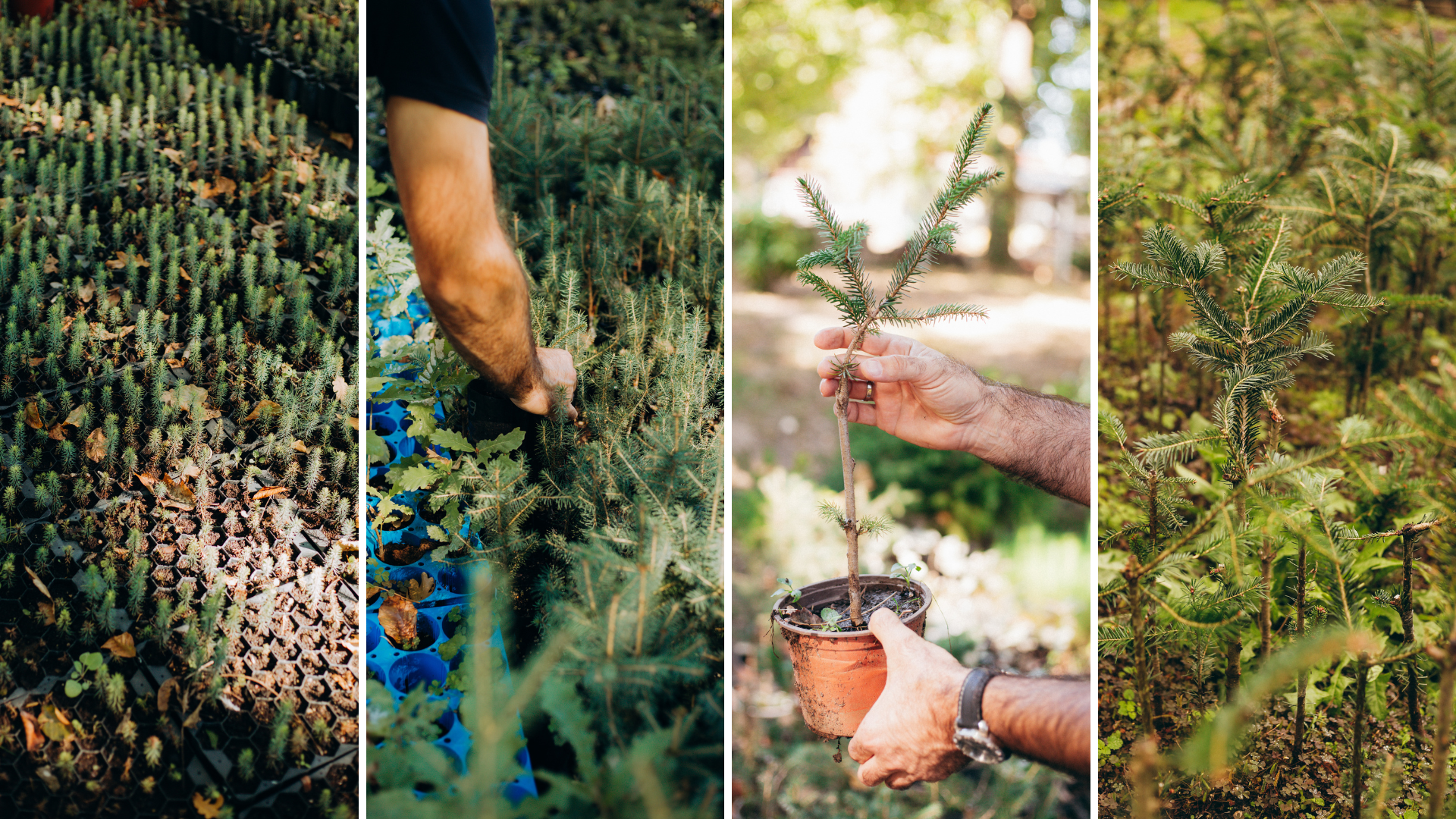
- Production of container seedlings
- Establishment of a seed plantation under experimental conditions
- Reforestation — planting across different terrains covering approximately 4 hectares
All activities are conducted under controlled conditions, while the process of production and preparation of seedlings for planting lasts around three years. The seedlings are then transferred to natural environments, at carefully selected locations that meet the ecological requirements for each species.
Project results — concrete steps toward restoring Serbia’s forests
After three years spent in the complex process of seed production and seedling preparation, we are proud to highlight the planting of 450 pyramidal fir trees on Mount Goč, as well as the restoration of natural habitats on Mount Javor.
The pyramidal fir is considered an endangered plant species and an exceptionally important rarity, and with the support of PS Fashion, the Institute of Forestry has successfully initiated the restoration and increase of its population, a process that will continue in the years ahead.
The nursery in Ivanjica currently contains around 500 grafted pyramidal fir seedlings ready for autumn planting, as well as approximately 5,000 seedlings grown from seed, which are still being additionally examined to confirm the species’ characteristics. Each year, 500 new seedlings will be planted on Goč, Javor, and Golija in order to reduce the risk of the species’ complete disappearance due to fires and other natural disasters.
The nursery also currently contains around 11,000 Serbian spruce seedlings produced from seed, along with an additional quantity obtained through grafting. The development process is extremely complex and slow — from production to planting and full rooting, it takes between three and five years. During the spring and autumn of next year, the planting of around 12,000 young plants is planned across selected locations throughout Serbia.